OllyGarden at KubeCon + CloudNativeCon North America 2026
- Events
- Community
- OpenTelemetry
KubeCon + CloudNativeCon North America 2026 in Salt Lake City: our talk on operating agents on Kubernetes, a panel on agents on the platform, a live Rose demo at booth 356, and the Trust Your Telemetry game.
KubeCon® + CloudNativeCon® North America 2026 took place November 9 to 12 at the Salt Palace Convention Center in Salt Lake City, and AI agents ran through much of the program: how to run them, how to secure them, and how to understand what they actually did. OllyGarden presented a talk on operating autonomous agents on Kubernetes®, joined a panel on agents on the platform, demonstrated Rose live from booth 356, and ran a telemetry game for visitors. Here is what we presented and why it matters.
Cloud Native AI + Inference Day
Agents are not microservices: operating autonomous AI on Kubernetes
Lanay Marques (OllyGarden) & Henrique Santana (AWS) | Monday, November 9, 2:05 PM | Watch on YouTube
Deploying a model inference endpoint on Kubernetes is well understood. Deploying autonomous AI agents is not. This talk starts from the ways agents break assumptions that Kubernetes workloads usually rely on: pods hold state across interactions, resource consumption is unpredictable (idle, then a burst), health checks fail on pods that are "thinking," autoscalers cannot predict demand from agents that spawn sub-tasks dynamically, and graceful shutdown means waiting for multi-step reasoning to finish.
From there, the talk identifies where Kubernetes primitives fall short for agentic workloads and what operators can do today. It covers adapted liveness and readiness probes for long-running inference, scaling strategies for unpredictable downstream load, graceful termination for multi-step reasoning chains, and communication patterns between agents using MCP and A2A on Kubernetes. Each gap is paired with a working pattern built from existing Kubernetes features and CNCF projects.
Main conference
Agents on the Platform: Four Perspectives on the Conversation We're Already Having in Private
Kasper Borg Nissen (Dash0), Joseph Sandoval (Adobe), Jed Salazar (Edera), Alexa Griffith (Red Hat) & Juraci Paixão Kröhling (OllyGarden) | Tuesday, November 10, 4:40 PM | Watch on YouTube
The panel took up a question platform teams are already asking: what happens when AI agents become workloads that need to be deployed, secured, observed, and maintained? Five ideas stood out.
Build on what the platform already does. Agents can run for a long time, call multiple services, create subagents, delegate work, and suspend and resume. That raises real questions: which identity should an agent use when it resumes, and how do you trace an action it delegated to another agent? But scheduling, compute management, and workload orchestration are not new problems. The advice from the panel was to understand what your existing platform can already do before building a new one for agents.
Autonomy changes the security model. Traditional microservices follow paths engineers can anticipate. Agents are nondeterministic, and the more autonomy they get, the more they can do. The panel discussed granular workload identities with SPIFFE and SPIRE, stronger isolation with sandboxes and microVMs, restricted network access through policies and proxies, and capability-based permissions that authorize specific actions while keeping the underlying credentials outside the agent's environment. Security is no longer only about protecting an application from outside threats. It is also about controlling what an autonomous application is allowed to do.
Observability has to show what the agent did. An HTTP 200 shows a request succeeded, not that the agent did the right thing. Alexa stressed comparing expected behavior with what actually happened across the steps of a workflow. Juraci added that observing an agent from the outside is not enough: teams need instrumentation inside the application that captures what the agent was trying to accomplish, which tools it called, what it delegated, and whether the result matched the intent. This is the business-level instrumentation engineers have long argued for in microservices, and it matters even more with agents.
OpenTelemetry® standards are a foundation to build on. Years of work on distributed tracing, context propagation, and standardized telemetry give agent observability a head start. Traces are becoming central to following a request across models, tools, services, and other agents. Context propagation is the critical piece: when one agent delegates to another that calls a tool over MCP or talks to a peer over A2A, losing context makes the execution impossible to reconstruct. The panel also touched on the GenAI semantic conventions in the OpenTelemetry® project, which have to balance moving quickly with not standardizing protocols and frameworks that are still changing.
Start with practical experience. Build, buy, or wait? There was no single answer. The panel recommended learning how the underlying systems work, using existing cloud-native capabilities where possible, experimenting with small but complete projects, and contributing to emerging standards. The closing remark was the most practical one: "You gotta get tracing. You gotta start there."
Beyond the stage
Rose live at booth 356
On Wednesday, November 11, at 1:00 PM MST, OllyGarden demonstrated Rose, its AI OpenTelemetry engineer, at booth 356. Starting from a service with no instrumentation, Rose opened a pull request that adds OpenTelemetry instrumentation using Minimum Viable Instrumentation (MVI), ready for the team to review before merging. Demos of OllyGarden's products ran throughout the week, mainly Rose.
Zero-code instrumentation gives teams broad coverage quickly. MVI builds on that foundation with deliberately chosen spans and attributes that describe business operations, so traces carry useful context without unnecessary noise. Rose works in an isolated, credential-free sandbox, proposes changes through pull requests, and never merges or writes to the default branch. It is tuned for Go, Java, JavaScript/TypeScript, and Python. The demo followed the same logic as the panel: if understanding an agent depends on instrumentation that captures intent, tool calls, and delegation, someone has to write and maintain it, and a pull request that people can read and approve is a practical way to keep up.
One visitor, John DeMoss of Jack Henry, shared this feedback in his KubeCon recap on LinkedIn:
"OllyGarden's instrumentation-first approach to OpenTelemetry really stood out. I particularly liked how they're combining telemetry quality analysis with AI tooling that can identify instrumentation issues and propose fixes directly in source code through pull requests. It's refreshing to see tooling that connects finding problems with actually helping engineers fix them."
Trust Your Telemetry?: the booth game
Visitors could also play Trust Your Telemetry?, a game built around real-world telemetry cases. For each case, players see the situation and the telemetry behind it, and have to decide whether it can be trusted or whether it hides a problem. After each answer, the game reveals the verdict and explains what the telemetry was really saying. The players with the best scores won a LEGO Rose, and the game was well received at the booth. It is still available to play at ollygarden.com/resources/trust-your-telemetry.
OllyGarden and Causely
The week built on a collaboration with Causely. Ahead of KubeCon, on November 2, Juraci and Causely published a joint post on both companies' blogs, Your agents trust your telemetry. Should they? OllyGarden covered telemetry quality and Minimum Viable Instrumentation, and Causely covered causal reasoning and its agent benchmark. The shared question: if agents rely on telemetry to reason about production, how much can they trust it?
The two teams then continued the conversation on video, starting from a simple question: AI agents are writing more code, but do we really need more telemetry? If agents produce far more code, telemetry cannot grow at the same rate, but agents can write code that is well instrumented from the start. More code also means more frequent failures, so agents need to help keep environments reliable and not only write code. And while the signals stay the same (logs, traces, metrics, and profiles), what a good trace looks like changes, so engineers have to relearn it. Agents, in turn, need to understand an application's intent and its likely failure modes to use telemetry well.
The team
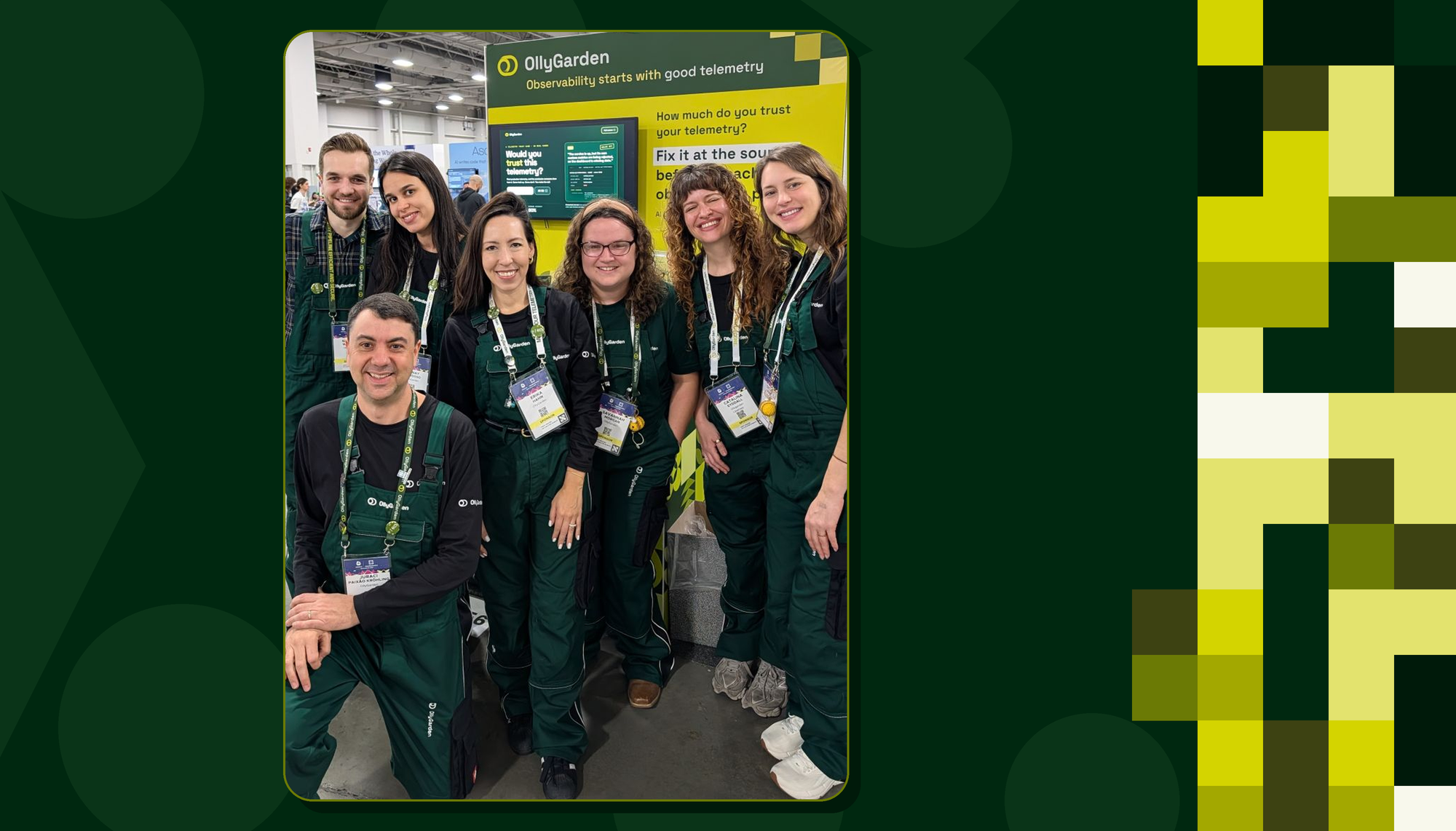
The OllyGardeners were in Salt Lake City, and being at booth 356 meant talking directly with the platform teams and observability engineers who use, or are about to use, what we help build. See you at the next one.
A common thread
The talk, the panel, and the demo approached the same problem from three directions. The talk showed where Kubernetes needs adapting to run agents, the panel showed how much of the existing platform and the OpenTelemetry project still applies, and Rose showed how the instrumentation behind it can be proposed in a pull request. AI agents make systems harder to predict, and the answer is not more data. It is better telemetry: meaningful, contextual, and consistent signals that let teams investigate what happened and improve the system.
These are the problems OllyGarden works on every day. Thank you to everyone who attended the sessions, stopped by booth 356, or came to talk telemetry with us in Salt Lake City.